# Timeline of Events
# Pandora’s Box | 1991 - 2001
# Humanity’s Final Golden Age: A Precursor to Collapse
In the early years of the 1990-2000s, prior to the cataclysmic events of the now well known "Black Mesa Incident", humanity stood upon the precipice of what many historians now call its final golden era, marked by both its greatest achievement... and its greatest failure. This was a time lead by an unprecedented surge in scientific, economic and technological advancement driven by the lingering echoes of the Cold War. Despite its end, the rivalry between the powers that be continued throughout- not by any means of warfare or some propaganda campaigns, but through a invisible competition for scientific supremacy.
All the Major powers of this era were swept up into the wave of progress. China led their charge forward as a logistical and militaristic powerhouse, developing advanced and key military technologies, alongside civil mass-production infrastructure. The United Kingdom focused on civil welfare, quality of life, revolutionary healthcare and genetic studies, and its crowning achievement was its consumer level technologies. The European Union was blessed with the gift that kept on giving.
However, it was the United States of America and the Russian Federation pushed more into the territories of science fiction without a word to their allies. Behind the curtain of public sciences, both governments possessed shadow research corporations and divisions that made significant progress into fields that defied conventional reality. Amongst the Americans, they were home to 2 of the most prestigious institutions, "Black Mesa" and "Aperture Science". Both Organizations concealed themselves and their activity through innocuous-sounding shell companies; Aperture hid behind "Arbeit Communications" a rather bland telecommunications firm used to mask complex research; as for Black Mesa... they used a variety of various companies and military logistics to hide their core projects.
[](https://wiki.willard.network/uploads/images/gallery/2026-03/zfPimage.png)
On the other side of the world within the lands of Mother Russia, the equivalent was known to only a select few high-ranking members and workers of its government, K.R.O.T, **Клинический Резонансный Отдел Технологий** (Clinical Resonance Department of Technology). To the outside world, it operated under the guise of the Novosibirsk Logistics & Materials Trust, ostensibly a corporation focused on logistical supply chains and industrial material handling. Though, in truth, similar to its American counterpart it focused on pioneering its own clandestine developments, including but not limited to: Resonance technology, weaponized energy research and speculative biomechanical soldier enhancement- a feat which would later come back to haunt humanity.
Throughout the years, these secretive institutions made great leaps forward in several classified domains. Breaking through theories around Quantum entanglement, spatial rift manipulation, portal and teleportation technology as well as experiencing the realm known as Xen. Each org made their own developments, Black Mesa became known for its cargo walkers and prototype teleportation chambers, including its most valued assets like the Lambda facility and Anti-Mass spectrometer. Aperture pushed the lines of ethics too far with its creation of GLaDoS- a fully sentient artificial intelligence system. While it did develop portal technology, special variety of gels and its variety of defense systems... the AI it had developed infamously turned against them- utilizing weaponized autonomy and chemical euthanasia.
K.R.O.T had also explored similarly hazardous ground- despite very few records surviving the test of time, fragments of its history suggest they succeeded in developing short-range teleportation nodes and primitive gravity-manipulation platforms, alongside its creation of energy-based weaponry, the first of its kind. However... their ventures in the fields of enhanced infantry eventually led to their downfall in the 2000s prior to the Black Mesa Incident. The facility had lost contact with the outside world at some point during 1999-2000 and all fragments suggested something within its grounds had murdered all facility staff and personnel... only the sleeping enhanced soldiers survived.
To the wider world, these monumental developments remained hidden beneath a thin veil of mundane consumer progress such as faster computers, more efficient vehicles, and routine military innovation. Only a handful of foreign intelligence services suspected the scale of what was unfolding, though none were able to pierce the obfuscating layers of disinformation and corporate secrecy.
Then, in the year **2001**, the veil was violently torn away.
This year brought the calamity that is widely known today as the "Black Mesa Incident", or more precisely, the Resonance Cascade. An event that shook the world to its core. Official records hint at procedural oversight, improper calibrations, inability to follow proper safety protocols or perhaps even just arrogance of the part of Management. However, in modern times many believe a more deliberate force was at work, one that intended on tearing a rift between Earth and the borderworld of Xen. This event caused many interdimensional entities to arrive, matter contamination to spread and chaos to erupt globally.
To humanity, it was an accident.
To others, it was an invitation.
To the **Combine**, it was a signal.
The golden age had ended.
#### **The Incident Unfolds: Containment and Collapse**
[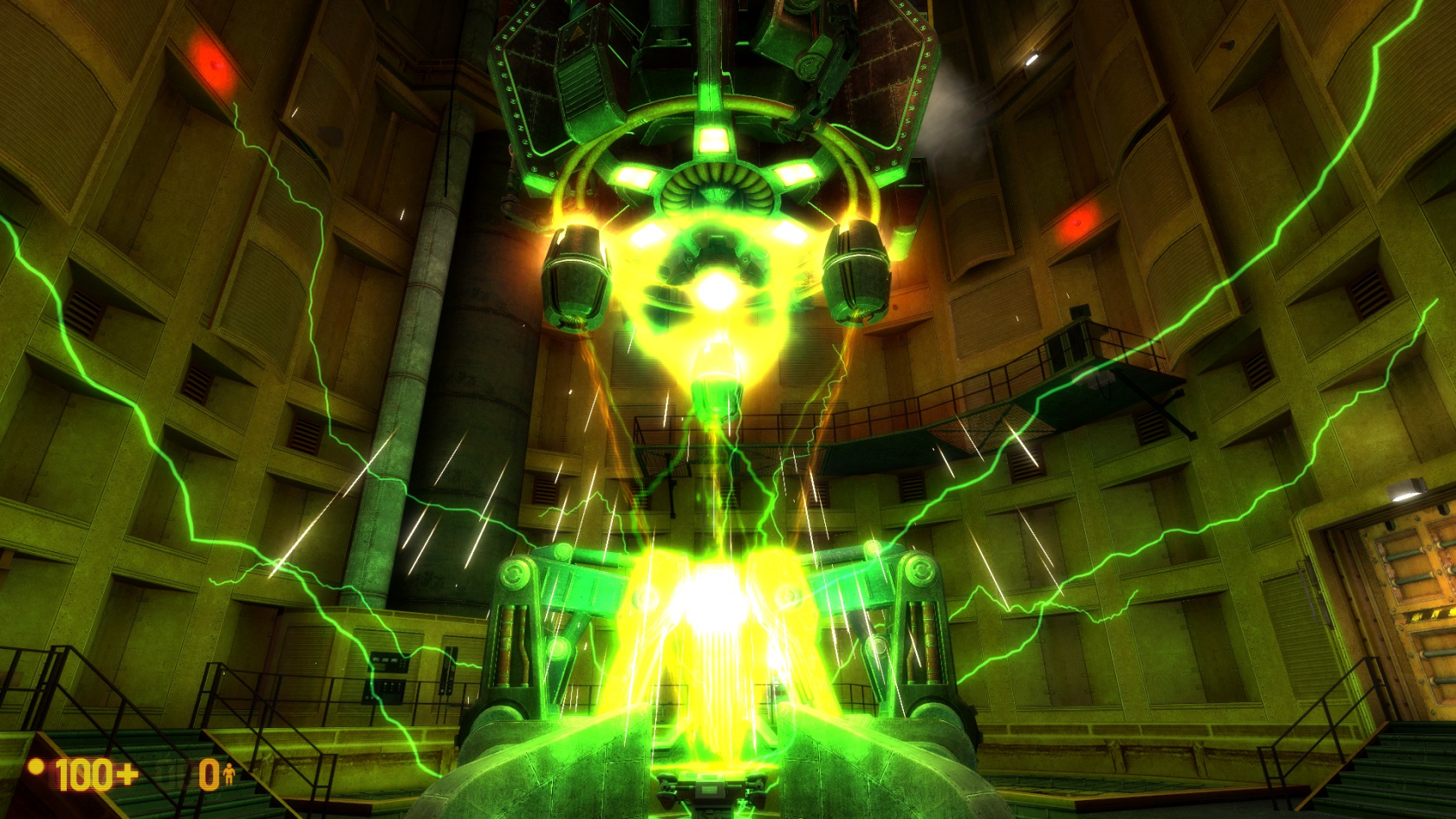](https://wiki.willard.network/uploads/images/gallery/2026-03/image.png)The precise timeline of the Black Mesa Incident remains shrouded in classified documentation, corrupted archives, and scattered eyewitness accounts. What is known is that the resonance cascade event began shortly after a routine materials analysis experiment involving alien crystal samples, imported from Xen, went catastrophically wrong. This cascade allowed and Entity within the borderworld of Xen to hold open a variety of rifts in spacetime that allowed the forces of Xen to breach through unto Earth within the Black Mesa facility.
Within hours, the facility became a warzone. Communications were severed, containment protocols failed, and the site's internal security forces were quickly overwhelmed by alien fauna and phenomena. Gargantuans, Vortigaunts, and otherworldly creatures hunted through the dimly lit corridors, slaughtering scientists, engineers, and security personnel alike.
Recognizing the scale of the disaster, the **United States government** launched a rapid-response military operation under the guise of disaster containment. High-altitude flybys detected irregular radiation patterns and unexplained gravitational disturbances around the New Mexico facility. Elite units from the **Hazardous Environment Combat Unit (HECU)** were deployed with one directive: suppress all hostile entities and eliminate surviving Black Mesa personnel to maintain plausible deniability.
The situation deteriorated with startling speed. Attempts to quarantine the area failed as portal storms, spatial and temporal distortions created by the energy from the resonance; began erupting across scattered zones in the western U.S., followed by smaller anomalies surfacing globally. These storms tore open the fabric of reality, unleashing further alien incursions in seemingly random, energy-prone regions. Major population centers were largely spared in the early days, but rural areas, research sites, and military installations became points of chaos.
By the second day, the illusion of containment was shattered. What was initially treated as a localized research accident had transformed into a full-blown extraterrestrial invasion. Global intelligence networks intercepted fragmented data, and international panic began to simmer. Some nations mobilized armed forces preemptively; others shut down borders. The **United Nations**, still reeling from the initial reports, struggled to coordinate any meaningful response.
In desperation, a classified nuclear strike was authorized by the U.S. government in an effort to destroy the facility and close the dimensional rift at its source. The warhead was delivered and armed until an unexpected disruption by an internal Black Mesa figure halted the detonation.
The scientist in question was **Dr. Gordon Freeman**, a theoretical physicist and Black Mesa employee who had survived the initial cascade and fought his way through the collapsing facility. Eyewitness reports from surviving personnel described Freeman as an almost mythical figure—unrelenting, silent, and lethal—making his way through not only alien resistance but the very military force sent to kill him. It is said that Freeman personally sabotaged the nuclear failsafe during his ascent through the Lambda Complex, buying precious hours for remaining survivors and triggering a chain of events that would echo across the planet for decades.
By the time the situation stabilized—if such a word can be applied—the world was no longer the same. The truth of Black Mesa was out. Secret projects, alien incursions, and interdimensional instability had been exposed not just to the American public, but to the entire planet. And somewhere far beyond Earth, something had taken notice.
# The Interim Years | 2001 - 2004
# Post-Black Mesa: The Descent into Chaos
In the wake of the Black Mesa Incident and the cataclysmic explosion that followed, internal U.S. military channels were swift to pronounce the young scientist, **Dr. Gordon Freeman**, as dead. His last known location—deep within the Lambda Complex—was obliterated in the blast. Yet one curious detail lingered: the file on Freeman remained open. Investigative branches within the Department of Defense, and later a classified joint intelligence task force, attempted to piece together how a lone theoretical physicist had survived a full-scale military lockdown, maneuvered through an alien invasion, and ultimately vanished without a trace. Some internal theorists speculated he had transported himself to the same dimension the invaders had emerged from—**Xen**—but the leads ran cold, buried beneath bureaucracy and classified silence.
The world, meanwhile, had little time to dwell on missing scientists or theoretical portals. What followed was worse.
The rupture at Black Mesa had permanently scarred the dimensional fabric of Earth. **Portal Storms**, once chaotic but brief, began sweeping across the globe in unpredictable patterns. But unlike the chaotic rift-driven activity during the Black Mesa crisis, these storms were stranger—**larger, more violent, and inexplicably strategic**. Global leaders and scientific communities scrambled for answers, but none came. Instead, the world faced something far more terrifying: **the full emergence of Xenian lifeforms onto Earth’s surface**.
But something was wrong. Initial xenofauna sightings revealed bizarre behavior. Creatures that had previously appeared to act in coordination now seemed fragmented—**feral, aimless, and in many cases, openly hostile to one another**. The illusion of a singular alien invasion force collapsed. Most notably, the species later identified by ex-Black Mesa researchers as **“Vortigaunts”** broke away entirely from the others. Once enslaved, the Vortigaunts vanished into hiding, shedding their bindings and fleeing deep into the Earth’s untamed wilderness.
There, far from human cities, unarmed civilians and survivalists began reporting sightings: tall, green-skinned aliens gathering near rivers, constructing crude shelters with salvaged human materials, cooking near campfires. Makeshift Vortigaunt camps began appearing in caves, abandoned mines, and ruined industrial zones—anywhere remote enough to avoid attention. Despite their pacifism and clear disinterest in conflict, **humans continued to hunt them down**, driven by fear, trauma, and a deep-seated distrust of anything alien. **Public prejudice was rampant**. Media networks warned of hidden threats; paramilitary groups raided suspected alien enclaves; local governments quietly authorized “shoot-on-sight” policies in some areas.
All the while, the world continued to burn.
**Portal Storms** became more frequent and less predictable. In some cases, rifts opened **within city centers**, tearing through homes and buildings, unleashing alien fauna into crowded urban districts. Civilian casualties spiked. Governments issued states of emergency. In the absence of coordinated global action, **local police forces were militarized overnight**. In countries across the world, SWAT units became the norm. Standard-issue pistols were replaced by automatic rifles. Armored vehicles rolled through downtown streets. Curfews were enacted. Martial law was declared in over a dozen nations within the first two years.
The rising chaos was a fertile ground for extremist ideologies. **Terrorist organizations and anarchist gangs flourished**, leveraging the public’s panic to justify their own warped agendas. Conspiracy theorists insisted the alien threat was a hoax—fabricated by governments to enforce global control. Others leaned into apocalyptic beliefs, claiming the events were divine punishment or evidence of impending biblical judgment. Cults emerged, some worshiping the alien invaders as gods. Others sought to **accelerate societal collapse** through coordinated attacks on relief centers, government facilities, and scientific institutions.
Amidst the madness, a grim truth became evident: **Earth was not merely suffering from an invasion—it was becoming a fractured battleground**, its people divided not only by species, but by fear, ideology, and desperation.
And all the while, above the chaos, **something was watching**.
---
Despite the global reach of the crisis, **not all nations suffered equally**. The sudden emergence of interdimensional rifts created an **asymmetrical disaster**, with some regions facing total collapse while others remained relatively intact—at least, for a time. **North America**, due to its proximity to Black Mesa, endured the earliest and most concentrated dimensional ruptures. Entire stretches of the **American Midwest** became uninhabitable, swallowed by storms and reshaped by alien life. The **Southwest Corridor**, once arid desert, was overtaken by lush but hostile flora that defied earthly classification—fungal forests, bioluminescent marshes, and razor-vine thickets. Locals began calling it the **Red Verge** due to the eerie crimson hue the atmosphere took on during heavy storm activity.
In **Eastern Europe**, the alien influx led to scattered but deeply entrenched "zones of corruption." A particularly violent storm cluster formed over the Carpathian Basin, creating the first officially recognized **XMZ – Xenian Malignancy Zone**. NATO forces attempted to secure the area, but ground conditions deteriorated rapidly. The XMZ became a **biological no-man’s land**, where Vortigaunts, Headcrabs, and stranger things roamed freely. Communications broke down, and satellite scans showed tectonic warping and anomalous weather patterns—a dead zone where the natural laws of Earth had begun to break.
**Asia** fared no better. Regions of **Central China and rural Mongolia** saw rift zones burst open in uninhabited wilderness, allowing bizarre alien megafauna to flourish undisturbed. There were unconfirmed reports of “colorful islands” hovering over the Gobi Desert, and groups of subterranean creatures known as "Antlions" built colonies tunneling under now-abandoned coal towns. The Chinese military sealed off entire provinces. Border conflicts erupted as refugees fled south into Vietnam, Korea, and Russia. Meanwhile, **Southeast Asia's** jungles became infested with fast-growing, spore-heavy vegetation that converted entire river systems into fungal ecosystems. Locals began referring to these warped zones as **“Green Death Valleys.”**
In **Africa**, particularly along the **Congo Basin**, alien growth accelerated beyond any known region. Portal Storms were rarer, but more intense. When they appeared, they left behind **Xen Spore Towers**—massive, semi-organic towers that embedded themselves into the soil like roots, spreading tendrils for kilometers. These towers began altering the local biosphere, replacing native plant life with alien ecosystems in mere months. The **UN and African Union** declared these regions as **Category-Red Terraform Incursions**, marking the first signs that Earth’s environment itself was beginning to lose the fight.
**Europe** fractured under pressure. The **European Union** failed to maintain unity after the first XMZ formed in Hungary. Member states began closing borders, hoarding supplies, and redirecting military forces inward. **France and Germany** formed bilateral security pacts to secure their urban centers, while **Italy and the Balkans** descended into prolonged civil unrest fueled by economic collapse and alien panic. The EU Parliament was eventually evacuated to **Oslo**, where it remained under emergency lockdown, reduced to a skeleton advisory body. NATO attempted to enforce joint operations, but growing political instability, alien storm unpredictability, and civilian resistance **fragmented its command structure**. By Year Two of the Crisis, NATO ceased to exist as a functioning coalition, replaced by regional defense blocs acting independently.
**South America and Oceania**, while distant from early rift zones, were not spared. **Brazil’s rainforest** mutated under the influence of spontaneous micro-rifts, becoming home to unseen creatures and whispering air currents that defied physics. Meanwhile, **Australia’s Outback** was rocked by seismic anomalies and scattered alien migration trails—deep gouges in the landscape left by titanic synth-like organisms roaming inland with unknown purpose. The continent’s isolation provided temporary security, but xenofauna began appearing in cities like **Perth and Darwin**, possibly via ocean-borne spores.
To monitor and catalog these alien hotspots, a coalition of remaining scientific and military institutions created the **Global Rift Monitoring Network**. Using modified satellites and deep-sensor drones, they charted major interdimensional regions and designated them with threat-level classifications. Among the most infamous:
- **XMZ-1 “Red Verge”** (USA – Midwest): A once-dry region now overgrown with volatile alien flora. Birthplace of semi-intelligent “Stalkers”—plant-based predators that camouflage among local growth.
- **XMZ-4 “Iron Hollow”** (Carpathian Basin): A psychic echo-zone where electronic equipment fails and living organisms report hearing distant voices. Site of at least five NATO task force disappearances.
- **XMZ-6 “Spire Wastes”** (Congo): Dominated by towering Xen Spore Towers, surrounded by warped ecosystems and aggressive terrain-changers. Entry forbidden by all African Union mandates.
- **XMZ-7 “Skywell Belt”** (Gobi Desert): The only known terrestrial location of floating organic leviathans. Entire towns beneath their flight paths vanished under unexplained circumstances.
As the Earth’s surface shifted from known geography into the unrecognizable, **humanity’s shared identity began to fracture**. The social contract, already under strain from economic panic and militarization, began to dissolve. Governments turned inward. Populations became isolated. Survival—not cooperation—became the new currency.
And still, through it all, **the storms never stopped**.
---
By the third year of the Crisis, amid the rising tide of alien wild zones and collapsing state infrastructure, **a new type of sighting began to circulate**. At first, they were dismissed as misclassified Xenian offshoots—unidentified bipedal figures clad in smooth armor, operating in silence and moving with mechanical precision. These figures were reported near active rift zones, abandoned cities, and key communication hubs. Witnesses gave conflicting descriptions: some said the figures had no faces, others swore they emitted soft, high-pitched radio clicks. Initial analysis suggested a **non-Xenian origin**, but in the absence of solid intelligence, most military and scientific institutions filed them under “Category-G: Unidentified Riftborne Entities.”
In a declassified NATO field report, a **French Forward Observation Team stationed outside the remnants of Strasbourg** described a “tower-shaped construct” appearing suddenly at the heart of a storm before vanishing minutes later, leaving behind a scorched crater and signs of intense radiation. No known Xenian activity had ever produced anything similar. Days later, the same team reported the loss of their recon drone to an “invisible signal surge,” followed by the disappearance of three soldiers during a patrol—none of their tracking gear activated, and their vitals ceased transmission mid-sentence. Locals began referring to the craze of 1900s UFO sightings, believing the aliens to now be showing themselves in this time of crisis.
Unknown to Earth at the time, these were not Xenian anomalies at all—but the **first scouting operations of the Combine**. **Synthetic reconnaissance units**, shielded from conventional detection, had begun charting Earth’s geography, atmospheric composition, and strategic weak points. These vanguard entities—probing, watching, never engaging—moved with purpose and coordination. In a post-war file recovered by resistance archivists, one transmission fragment labeled the operations as **“Spherical Sector 314: Phase One Dissection”**
At the time, however, no one suspected Earth was being measured—not merely for occupation, but for **assimilation**.
# Europe Between the Black Mesa Incident and the Seven Hour War
## Initial Context: The Chaos of 2001
When the Black Mesa catastrophe tore through Earth's dimensional fabric in 2001, Europe was quickly overwhelmed by a wave of Xen incursions. Unlike the United States, which had Black Mesa as its epicenter, the Old Continent faced scattered but devastating portal storms. Hungary was among the first hit, with the Carpathian Basin becoming what would later be called XMZ-4 "Iron Hollow," a zone where electronic equipment ceased to function and ghostly voices haunted survivors.
The first days were marked by total confusion. The mechanisms of the European Union, already weakened by persistent divisions regarding the intervention in Iraq, collapsed almost immediately. Brussels, faced with the impossibility of coordinating an effective response to threats that were simultaneously emerging in Hungary, France, and Italy, quickly became obsolete. The European Parliament was evacuated urgently to Oslo, where it would be reduced to a mere skeletal consultative body.
## The Collapse of NATO and the American Question
### European Expeditionary Forces in the USA (May-June 2001)
During the first weeks of the crisis, NATO still seemed functional. When the United States, overwhelmed by Xen incursions on their East Coast, requested the activation of Article 5, several European nations responded. Expeditionary forces were rapidly deployed:
- **United Kingdom**: 12,000 soldiers, mainly Royal Marines and SAS
- **France**: 8,000 soldiers, including Foreign Legion and special forces
- **Germany**: 6,000 Bundeswehr soldiers
- **Netherlands, Belgium, Denmark**: smaller contingents (2,000-3,000 each)
These forces arrived in New York and Boston in early June, discovering indescribable chaos. American cities were ravaged, command chains broken, and Xen creatures swarmed everywhere. More troubling still, the Europeans quickly discovered the truth: Black Mesa was a man-made incident, the result of forbidden experiments on extraterrestrial materials.
The diplomatic scandal was immediate. European commanders, furious at being sent to die cleaning up an American disaster, demanded immediate repatriation. But at the same moment, incursions began to multiply in Europe. Expeditionary forces were recalled urgently, leaving only a few liaison units.
### The Problem of American Bases in Europe
The revelation about Black Mesa created a major crisis concerning American military bases in Europe. NATO installations – Ramstein in Germany, Aviano in Italy, British bases – housed tens of thousands of American soldiers. Faced with their country's collapse, these troops became problematic:
- Failed repatriation attempts to the USA (June-July 2001) due to transatlantic portal storms
- Growing tensions between desperate American soldiers and local populations
- Mutinies in certain bases when Washington ordered troops to remain in Europe
- Mass desertions of American soldiers seeking to return by their own means
By August 2001, most American bases had been either chaotically evacuated or forcibly absorbed by European national armies. American equipment was seized and redistributed, de facto creating the end of NATO as an operational structure.
## The Establishment of the Oslo Defense Council
It was in this context of institutional panic that an alternative emerged. At the end of May 2001, as portal storms intensified and Xen flora began to infest Europe's major metropolises, defense ministers from several nations met informally in Oslo. The Norwegian capital offered several strategic advantages: its geographical position removed from major rift zones, its proven diplomatic infrastructure, and above all, its relative neutrality in the quarrels dividing Paris, London, and Berlin.
What began as informal consultations quickly transformed into a permanent European Defense Council. Faced with NATO's collapse whose command structure had disintegrated in just a few weeks and the manifest impotence of the EU, Oslo became the new nerve center of continental defense.
The Council quickly equipped itself with an operational structure: the European Continental Defense Army (ECDA). Unlike traditional military structures, the ECDA was designed as a rapid intervention force capable of responding to Xen incursions without getting lost in the bureaucratic maze that had paralyzed the EU.
## The Rise of General Hägglund and Military Integration
To command this new force, the Council turned to General Gustav Hägglund. Of Finnish origin, Hägglund was then President of the European Union Military Committee, a position that, ironically, had lost all relevance with the EU's collapse but which gave him precious institutional legitimacy. More importantly, his Finnish nationality made him an acceptable compromise for all: neither too close to the Franco-German axis, nor subservient to the British, and possessing substantial international experience acquired during multiple peacekeeping missions.
The integration of national armed forces into the ECDA was a chaotic and uneven process. The fifteen EU member states of the time reacted differently to the urgency of the situation:
**The Major Military Powers** quickly accepted the unified command structure, but with ulterior motives. France transferred its regional headquarters to the ECDA while secretly maintaining control of its nuclear strike force Hägglund would only learn much later that launch codes remained in Paris. The United Kingdom, traumatized by Southampton's rapid fall to Xen incursions, formally ceded its territorial commands but jealously kept control of the Royal Navy. Germany, whose Panzergrenadiers formed the backbone of the ECDA's ground forces, demanded and obtained that its generals occupy key positions within the new command.
**Medium Nations** like Italy, Spain, and the Netherlands adopted a pragmatic approach. Their general staffs were gradually integrated into the ECDA structure, their senior officers accepting subordinate positions in exchange for protection guarantees for their national territories. Italy, whose north was already compromised by Alpine incursions, had little choice. Spain fiercely negotiated the maintenance of its operational autonomy in the Iberian Peninsula, de facto creating a semi-independent command zone.
**Small Nations and Nordic Countries** Denmark, Belgium, Luxembourg, Austria, Portugal, Ireland, Finland, and Sweden merged their forces almost immediately with the ECDA. Some, like Luxembourg, simply lacked the capacity to resist alone. Others, like Finland, saw in this integration a chance for disproportionate influence thanks to Hägglund's position. Greece, geographically isolated and facing heavy incursions in the Balkans, was the last country to join the ECDA. However, in 2003, it faced a major catastrophe with the massive portal storm known as **“the Wild Hunt.”** Already weakened by areas under enemy control, the country was brought to ruin. Nevertheless, Greek refugees were resettled across the **SSZs**, fostering greater cultural diversity throughout these zones.
The "Framework Nation" model was quickly adopted: the United Kingdom and France provided projection capabilities and naval command, Germany provided armored forces, while smaller nations contributed specialized units the Dutch excelled in amphibious warfare, the Finns in contaminated zone operations, and the Spanish in urban guerrilla warfare.
## The Vortigaunts: Persecution and Exile
Following their appearance in Europe after the Black Mesa incident, Vortigaunts were deliberately reviled by human populations. Despite some evidence of their sentience, widespread fear and xenophobia led to organized hunts against these creatures. Vortigaunts became heavily persecuted and were driven into extreme exile, forced to hide in remote areas to avoid human extermination efforts. Most European governments either actively participated in or deliberately ignored these persecution campaigns, viewing the Vortigaunts as unwanted alien threats regardless of their apparent intelligence and peaceful nature.
## The Fate of Non-European Union Nations
The situation of non-EU European countries was even more dramatic. Without the institutional infrastructure, even weakened, that had allowed the formation of the Oslo Council, these nations had to face the Xen catastrophe in complete isolation.
**Norway**, despite its role as host of the Defense Council, fiercely maintained its military independence. Its NATO membership now dysfunctional and its relatively protected geographical position allowed it to negotiate a special status: Oslo provided infrastructure and logistics, but Norwegian Armed Forces remained under national command. This exception created constant tensions with Hägglund, who saw in this "semi-cooperation" a dangerous precedent.
**Switzerland** made its mountains and bunkers into a citadel, cut off from the outside world after the Saint-Bernard Tragedy. Behind destroyed borders and mined passes, the Confederation survived in total isolation thanks to the Swiss Civil Protection System, which imposed strict order: rationing, underground agriculture, and rotation between surface life and underground shelter.
Despite this confinement, the country preserved its singular identity: elections continued to be held, sometimes in fortified halls, maintaining the fragile illusion of a living democracy at the heart of a collapsed world. Every citizen, enrolled in the militia and collective discipline logic, became simultaneously soldier, worker, and guardian of national survival.
Thus, Switzerland achieved this paradox: remaining a functioning democracy while living under an iron regime, protected by an implacable organization that made it a bastion of freedom... but a freedom confined in the depths of its shelters.
**The Balkans** plunged into absolute chaos. Croatia, Bosnia, Serbia, Montenegro, Macedonia, and Albania already weakened by the 1990s wars were overwhelmed by Xen incursions. Without modern military infrastructure and with weak governments, these nations imploded within weeks. Warlords emerged, controlling small fortified territories. Some made deals with the ECDA in exchange for protection, becoming de facto vassal states. Others sank into barbarism, even using captured Xen fauna as weapons against rivals. The region became what ECDA military called "the Gray Zone" neither controlled nor abandoned, but in perpetual war.
**Ukraine, Belarus, and Moldova**, caught between Western Europe and Russia, desperately tried to play both sides. Ukraine proposed its ECDA membership in exchange for protection against incursions from the east, but Hägglund refused, judging the country "indefensible" and fearing to irritate Moscow. Belarus turned to Russia, which de facto annexed it under the pretext of "fraternal protection." Moldova, abandoned by all, simply ceased to exist as a functional state in autumn 2001.
**Iceland** knew a particular destiny. Relatively spared from portal storms thanks to its geographical isolation, the small island nation became a refuge for European elites fleeing the continent. Scientists, artists, politicians, and wealthy industrialists flocked to Reykjavik, transforming the island into a sort of cultural Noah's ark. The ECDA established secondary command installations and research centers on Xen phenomena there. Hägglund himself made several stays there, fueling rumors that he was preparing a "government in exile" in case the continent was lost.
## First Victories and Power Consolidation
The first weeks under Hägglund's unified command were marked by relative successes that considerably strengthened his position. The ECDA managed to establish security perimeters around major urban zones still intact, evacuate civilians from emerging XMZs, and coordinate surveillance efforts via the Global Rift Monitoring Network.
The most notable operation was the "Battle of Lyon" in June 2001, where a combined Franco-German force repelled a massive incursion of Xen creatures threatening to engulf the city. The victory was presented by ECDA propaganda as proof that European unity could triumph over the extraterrestrial threat. Medals were distributed, monuments erected, and Hägglund was hailed as the "Savior of Europe" by media now under military control.
This victory, however, masked a darker reality. Civilian losses had been catastrophic it was estimated that nearly 40% of Lyon's population had perished. And the city itself had become uninhabitable, contaminated by Xen spores that resisted all decontamination efforts. Lyon was finally abandoned and declared XMZ-12 "Purple Valley" in August 2001.
## Fractures Within the Command
Despite the apparent unity of the ECDA, deep tensions undermined the command structure. National generals, accustomed to operational autonomy, poorly tolerated the centralization imposed by Hägglund. French General Bertrand Ract-Madoux, commander of ground forces, regularly opposed the Finn's strategies, which he judged "too defensive." British Marshal Sir Timothy Granville-Chapman openly criticized the "waste of resources" in defending Eastern Europe, suggesting a strategic retreat to an "anti-Xen Maginot Line" running from Calais to Marseille.
These divisions erupted during the "Prague Crisis" in October 2001. The Czech capital, surrounded by Xen incursions, desperately requested reinforcements. Hägglund ordered a major rescue operation, mobilizing German, Polish, and Austrian units. But the British and a faction of the French general staff refused to participate, arguing that resources would be better employed defending Paris and London. The operation took place nonetheless, but failed Prague fell, and nearly 15,000 ECDA soldiers were lost in the debacle.
Hägglund used this failure to purge his opponents. Accusing the "nationalists" of having sabotaged the operation through their inaction, he dismissed several recalcitrant generals and replaced them with loyal officers. General Ract-Madoux was "promoted" to an administrative position in Reykjavik a golden exile but effective sidelining. Sir Granville-Chapman resigned in protest and was immediately arrested for "wartime desertion." He would spend the following years in detention at a Norwegian military base.
This purge marked a turning point. National general staffs, witnessing the fate reserved for those who defied the Supreme Commander, submitted. The ECDA command structure became de facto a military dictatorship, where Hägglund's decisions were executed without discussion.
## The Authoritarian Drift
But it was during the summer of 2001, as portal storms intensified and new XMZs appeared in Eastern Europe, that Hägglund began to extend his authority beyond his initial mandate.
The turning point came in September 2001. Officially to "ensure the security of Council deliberations," Hägglund deployed ECDA units around the buildings where civilian representatives sat. These soldiers, presented as an "honor guard," were actually a control force. The Council's communications with national capitals were gradually filtered through military command. Strategic decisions, once debated and voted on, became simple ratifications of directives issued by the ECDA general staff.
The General justified this centralization by the necessity of reactivity against Xen threats. And he wasn't entirely wrong: parliamentary deliberations, even in crisis times, couldn't keep pace with incursions. But what had begun as a temporary emergency measure transformed into permanent governance.
By the end of 2001, the Oslo Defense Council was nothing more than a facade. Civilian representatives signed orders they didn't always understand, under constant surveillance by ECDA officers. Hägglund, now called "European Supreme Commander," concentrated in his hands power that far exceeded what any European leader had possessed for generations.
## The Precarious Stability of Controlled Zones
Despite this authoritarian drift, the ECDA managed to maintain a form of stability in territories under its control. "Secured Settlement Zones" (SSZs) were established around major metropolises still intact: Paris, London, Berlin, Stockholm, Madrid. These zones, heavily fortified, offered relative protection against Xen incursions and allowed the maintenance of minimal civilian life.
Xen flora was systematically burned or uprooted within several kilometers around each SSZ. Perimeter walls were erected first temporary barriers, then permanent reinforced concrete structures. Constant patrols monitored perimeters, while scientific teams studied means to counter the rapid growth of extraterrestrial vegetation.
Life in these zones was far from normal. Rationing was widespread, civil liberties drastically reduced, and permanent martial law in effect. But for many, it was preferable to the alternative: wild zones infested with Xen creatures, where Earth's laws of physics seemed no longer to apply.
## Nationalist Tensions
A major problem quickly emerged within SSZs: the national question. While the ECDA officially promoted European unity against the extraterrestrial threat, populations remained deeply attached to their national identities. Refugees flowing from compromised zones were often poorly received, perceived as additional mouths to feed in a context of growing shortage.
The French reproached the British for their "insular selfishness," while the latter accused continentals of mismanagement. Germans, traumatized by Munich's rapid fall to Xen incursions, developed a collective paranoia toward anything from the East. Central and Eastern European nations, whose territories had been most devastated, felt abandoned by the "privileged" West.
Hägglund attempted to contain these tensions by imposing an ideology of "collective survival" the idea that old national divisions were obsolete in the face of an existential threat. The ECDA was presented as a trans-national force, with units deliberately composed of soldiers of different nationalities. National flags were gradually replaced by the ECDA emblem a stylized shield surrounding the stars of the former European flag.
But these efforts remained superficial. In barracks, soldiers grouped by linguistic affinities. In SSZs, informal ghettos formed along ethnic lines. And when resources became particularly scarce, tensions erupted in open violence riots, looting, and sometimes even armed clashes between communities.
## The Yellowstone Collapse (2002)
In August 2002, Europe received the first seismic alerts from North America, followed hours later by satellite images showing the unthinkable: the Yellowstone supervolcano had collapsed upon itself in an apocalyptic explosion. An F7 Portal Storm, dubbed "Kaboom" by terrified observers, had torn through the volcano's depths, triggering an eruption of unimaginable violence. The explosion was so colossal that it annihilated half of Montana, Idaho, and Wyoming within minutes, creating a titanic crater visible from space. European seismic sensors recorded tremors comparable to a magnitude 9 earthquake, and atmospheric shock waves circled the planet three times. But the worst was yet to come. In the days following the eruption, European skies began to darken. Billions of tons of volcanic aerosols were propelled into the stratosphere, forming a planetary veil that blocked a significant portion of sunlight. General Hägglund urgently convened ECDA scientific advisors, who confirmed catastrophic predictions: an artificial ice age was inevitable and would last at minimum two years. European temperatures began to plummet as early as September 2002. The ECDA immediately declared maximum climate emergency status, launching Operation "Winter Refuge" a continental survival plan involving accelerated construction of thermal shelters, requisition of all fuel reserves, and massive conversion of buildings into heated greenhouses. Civilian populations were ordered to regroup in SSZ urban centers where collective heating was possible. Paradoxically, the Portal Storms themselves had absorbed a considerable portion of the explosion scientists estimated that without the F7 "Kaboom's" interference, the eruption could have been even more devastating. Nevertheless, the approaching winter of 2002-2003 promised to be the deadliest humanity had known in millennia, and the ECDA was preparing to fight on two fronts: Xen incursions and the mortal cold of a world plunged into volcanic darkness.
## The Wild Hunt and the Greek Catastrophe (2003)
In March 2003, while Europe was already battling the volcanic winter, the sky above Athens tore apart in a cataclysm of unprecedented magnitude. The Wild Hunt, classified F10 the highest category ever recorded materialized in a roar that was heard as far as Italy. Unlike previous Portal Storms that dissipated after hours or days, this one persisted, transforming into a permanent wound in reality. Its mere appearance was terrifying: a titanic maelstrom of purple and black, streaked with violet lightning, from which emerged what appeared to be spectral silhouettes riding deformed mounts hence its name inspired by the mythological legend of the Wild Hunt. Television images of this cosmic abomination triggered a wave of panic across all of Europe. General Hägglund immediately made the decision to abandon all of continental Greece, ordering an emergency evacuation toward the Aegean islands and Crete. ECDA units conducted desperate delaying actions, sacrificing entire regiments to allow civilians to flee. Command established the "Purple Curtain," a quarantine line extending from southern Albania to western Turkey, mobilizing three complete divisions and tens of thousands of soldiers. Reports from the first weeks were nightmarish: entities emerging from the Wild Hunt were not the usual Xen creatures, but shifting forms, spectral echoes, and phenomena defying all physical logic. In six months, more than 40,000 ECDA soldiers disappeared in the contaminated zone. The Wild Hunt didn't merely pour out creatures it transformed space itself, creating zones where time flowed differently, where gravity fluctuated, where the dead seemed to walk alongside the living. For the first time, ECDA command realized with horror that they weren't just fighting an invasion, but a permanent existential anomaly.
## Winter Lifts, But Darkness Remains (Approaching 2004)
As 2004 approached, Europe slowly emerged from the ice age triggered by Yellowstone. The veil of volcanic ash was finally beginning to dissipate, allowing the sun to pierce through the grayish haze for the first time in two years. Temperatures were gradually rising, but the damage was irreversible: two consecutive years without viable harvests had decimated food reserves, and famine had killed as many as Xen incursions. The ECDA, drained after mobilizing 40% of its personnel to keep populations alive during the endless winter, struggled to catch its breath.
In this context of general exhaustion, a strange lull manifested in Xen incursions across the continent but only **outside** of Greece. Portal Storms, once omnipresent, were becoming less frequent. Xen fauna, once aggressive and coordinated, now seemed erratic, almost disorganized. Vortigaunts, those humanoid creatures that had terrorized the early years, had practically disappeared from controlled zones some reports suggested they had taken refuge in remote areas, avoiding all contact with humanity.
But this lull was only a cruel illusion. To the south, the Wild Hunt continued to howl above Athens' ruins, as fierce as on day one. The Purple Curtain, that 200-kilometer quarantine line, still swallowed soldiers by the hundreds every week. The three divisions mobilized there were now ghost units, constantly reconstituted with new recruits to replace the disappeared. General Hägglund no longer spoke of "reconquering" Greece he spoke simply of "containing the abomination" for as long as possible.
The ECDA took advantage of the relative respite in the rest of Europe to attempt rebuilding what could be rebuilt. Existing security perimeters were consolidated, but no new SSZs were established resources were desperately lacking. Hägglund, now nicknamed "the Keeper of Ruins" by his detractors, launched salvage operations in certain abandoned zones, desperately searching for food stocks and equipment. The "restoration of European civilization" he had dreamed of had transformed into a daily struggle to simply keep survivors alive.
It was then that fragmentary reports began reaching the most advanced outposts troubling observations that corresponded to nothing known. Bipedal silhouettes in smooth armor, moving with mechanical precision near active rift zones. Tower-shaped structures appeared and disappeared within minutes, leaving behind burned craters. Surveillance equipment mysteriously ceased functioning, and entire patrols disappeared without a trace.
Within ECDA command, certain intelligence officers began formulating disturbing hypotheses: what if the Xen creatures had been only the vanguard? What if something else, something far more formidable, had been observing Earth from the beginning? What if this apparent respite was merely the calm before a storm of yet unseen magnitude?
Hägglund systematically suppressed these reports, classifying them as "unconfirmed speculation." He didn't want to alarm a population already on the brink of breaking, a Europe that had barely survived an apocalyptic winter and was still bleeding against the Wild Hunt. But in the secrecy of his office, late at night, the Supreme Commander studied these reports with growing concern. The pieces of a nightmarish puzzle were beginning to assemble.
Europe had survived Black Mesa. It had survived the four disasters. It had survived Yellowstone and its endless winter. It was surviving, barely, the Wild Hunt.
But for how much longer?
# France Between the Black Mesa Incident and the Seven Hour War
## Initial Context: Between National Sovereignty and European Coordination
When the Black Mesa incident tore through Earth's dimensional fabric in May 2001, France found itself in a paradoxical position. On one hand, it possessed one of Europe's most sophisticated armies with 260,000 active military personnel, an independent nuclear strike force, and a network of military infrastructures. On the other hand, the multiplication of portal storms and the rapid collapse of NATO and European Union structures forced it to accept supranational coordination that it had always jealously avoided.
## Reluctant Integration into the ECDA
During the formation of the Oslo Defense Council at the end of May 2001, France played a characteristic double game. President Jacques Chirac, confronted with massive Xenian incursions in the eastern part of the country and the collapse of Lyon under extraterrestrial pressure, formally accepted French membership in the European Continental Defense Army (ECDA). However, he secretly maintained exclusive control of the French nuclear deterrent force, refusing to transmit launch codes to General Hägglund.
This decision, which would only be discovered in September 2001 during the purge of nationalist generals, created permanent tension between Paris and Oslo. General Bertrand Ract-Madoux, commander of French ground forces and rising figure of the ECDA staff, embodied this French resistance to excessive centralization. His confrontation with Hägglund would culminate during the Prague Crisis in October 2001.
## Article 16 and Preparation for Sovereignty Transfer
Faced with multiplying incursions, President Chirac activated Article 16 of the Constitution on May 28, 2001, granting him exceptional powers. What was presented as a temporary measure quickly became a tool to facilitate the progressive integration of French administration into the ECDA structure. The territory was initially reorganized according to the defense and security zones system, but this national structure would rapidly be absorbed by the European Secured Population Zones (SPZ) system.
## The Battle of Lyon and First Losses (June 2001)
Lyon was the first major test of French capacity to resist Xenian incursions. In June 2001, a massive wave of creatures emerged from multiple rifts in the Rhône valley, threatening to engulf France's second metropolis. General Ract-Madoux, commanding the defense operation, coordinated a combined Franco-German force under ECDA aegis.
The battle raged for four days. While ground forces finally managed to repel the incursion, the cost was catastrophic: nearly 40% of Lyon's population perished in the fighting, approximately 500,000 people. The city itself was so contaminated by Xenian spores that it had to be evacuated and declared XMZ-12 "Purple Valley" in August 2001.
This pyrrhic victory was nevertheless celebrated by ECDA propaganda as proof that European unity could triumph. General Hägglund personally decorated Ract-Madoux, still unaware that the latter would soon become his main opponent.
## The Prague Crisis and French Purge (October 2001)
The Prague Crisis of October 2001 marked a turning point in relations between France and the ECDA. When the Czech capital, encircled by Xenian incursions, requested urgent reinforcements, Hägglund ordered a major rescue operation mobilizing German, Polish, and Austrian units.
Ract-Madoux, supported by a faction of the French staff, categorically refused to engage French divisions in what he considered a suicidal operation. He argued that these resources should be preserved to defend Paris and vital French zones. This insubordination, tacitly approved by Chirac who feared losing his best troops, contributed to the operation's failure. Prague fell, and 15,000 ECDA soldiers perished in the debacle.
Hägglund seized this opportunity to consolidate his power. Accusing Ract-Madoux and the "French nationalists" of having sabotaged the operation, he demanded and obtained the French general's resignation. Ract-Madoux was "promoted" to an administrative post in Reykjavik – a golden exile but effective removal from operational command. More importantly, this purge allowed Hägglund to impose a complete reorganization of French military administration, replacing national structures with the SPZ system directly controlled by the ECDA.
## The Erosion of French Administration (Autumn 2001 - Spring 2002)
### Progressive Transfer of Powers
Following the October 2001 purge, the French administration underwent radical transformation. The traditional system of prefectures and defense zones was progressively dismantled in favor of a centralized structure around Secured Population Zones (SPZ) controlled by the ECDA.
General Michel Mercier, named new commander of French forces after Ract-Madoux's disgrace, was a more malleable man, favorable to complete integration into the ECDA. Under his supervision, zone prefects were replaced by SPZ Commanders appointed directly by Oslo, often officers of other European nationalities.
Paris, Lyon (before its fall), Marseille, Bordeaux, Strasbourg, and Rennes became the centers of these SPZs, each administered according to ECDA standardized protocols. French republican institutions – local assemblies, civil services, national police – were progressively subordinated to European military authority.
### Bureaucratic Resistance and Repression
This transformation did not occur without resistance. French civil servants, attached to republican structures, attempted to maintain traditional administrative procedures. But faced with the urgency of the Xenian crisis and pressure from Oslo, these attempts were systematically crushed. In January 2002, the French Council of State attempted to contest the legality of the sovereignty transfer, but was purely and simply dissolved by presidential decree under pressure from Hägglund.
Chirac himself, initially reluctant to this absorption, was progressively marginalized. By March 2002, he was nothing more than a figurehead, mechanically signing decrees written by the ECDA staff. French sovereignty had become a legal fiction, maintained for propaganda reasons but emptied of all real substance.
## Brittany: Ephemeral Sanctuary (May 2001 - July 2002)
### Providential Geography
While eastern and southeastern France collapsed under Xenian assaults, Brittany emerged as an unlikely sanctuary. Its peninsular position, surrounded by the Atlantic Ocean on three sides, created a natural barrier against rifts that propagate mainly by land. The Armorican massif, ancient geological base, seemed to exercise unexplained resistance to dimensional disturbances.
General Philippe de Saintignon, initially OGZDS of the Western Zone based in Rennes, was maintained in his position but under direct authority of ECDA command. He quickly established a defensive perimeter using existing military infrastructures: the Brest arsenal, the nuclear submarine base of Île Longue, the military ports of Lorient and Saint-Nazaire.
### Massive Influx of Refugees
From July 2001, Brittany became the main refuge for populations fleeing the catastrophe. The first waves included nearly 200,000 Americans evacuated via Atlantic ports after the collapse of the American East Coast. Then came the Europeans: Germans fleeing the Bavaria and Saxony XMZs, Italians escaping the collapse of northern Italy, eastern French abandoning lost Alsace-Lorraine.
The Rennes-Brittany SPZ, under direct ECDA control, organized reception according to European standardized protocols. Refugee camps were established in rural communes, managed by ECDA multinational teams rather than traditional French local authorities.
By spring 2002, the population of historic Brittany had grown from 4.7 million to more than 8 million inhabitants, creating growing tensions. The Bretons, attached to their strong regional identity, watched with bitterness as their land was transformed into a refugee camp under foreign administration.
## Insidious Contamination (June-July 2002)
### First Signs
On June 15, 2002, an ECDA scientific team detected the first signs of Xenian contamination near Quimper. Unlike the explosive manifestations observed elsewhere, Breton contamination presented an insidious character: sporadic micro-rifts, discrete biological mutations of local fauna, subtle alterations of the coastal ecosystem.
The analysis suggested slow but inexorable propagation, probably favored by the exceptional population concentration and traces of residual contamination transported by refugees from infected zones. What had protected Brittany – its relative isolation – now became a trap: the peninsula was transforming into a zone of contamination concentration and amplification.
### Rapid Escalation
In July 2002, the situation deteriorated catastrophically. Xenian creatures began appearing in rural areas. The first cases of zombification were confirmed in refugee camps. The marine ecosystem showed alarming signs of alteration, with the appearance of hybrid forms in coastal waters – potentially threatening to contaminate the entire North Atlantic.
General de Saintignon, in coordination with ECDA scientists, assessed that contamination could become irreversible within 3 to 6 months, transforming Brittany into a corruption zone comparable to the lost territories of Central Europe. Worse still, contamination could spread eastward, threatening Paris and the last safe zones of France and Europe.
## The Massacre of Brittany: Operation Celtic Pyre (August 15-17, 2002)
### The Decision of the Oslo Council
On August 15, 2002, the Oslo Defense Council, under Hägglund's direction, made the decision that would haunt European conscience: Operation Celtic Pyre. This time, Chirac was not even consulted – he was simply informed of the decision and received orders to provide necessary air assets.
This decision was based on several factors:
- **Existential threat**: Breton contamination risked extending to all of Western Europe
- **Established precedent**: Lyon's sacrifice had demonstrated ECDA's willingness to use extreme means
- **Power centralization**: ECDA now had authority to make such decisions without consulting national governments
- **Scorched earth doctrine**: faced with an extraterrestrial threat, traditional humanitarian considerations were deemed secondary
General de Saintignon, charged with execution, protested but received direct orders from Hägglund to proceed. The man who had transformed Brittany into a sanctuary would now have to destroy it.
### Operation Execution
The operation mobilized massive air assets:
- 48 Mirage 2000D and Jaguar equipped with napalm incendiary charges
- 12 Super Étendard based at Landivisiau
- Logistical support from Lorient and Lann-Bihoué bases
- Coordination by ECDA rather than traditional French command
The evacuation order was only given 18 hours before strikes, creating indescribable chaos. Eastern roads were overwhelmed, ports saturated. Of the 8 million people present in Brittany, only 3.2 million could be evacuated to neighboring SPZs.
The napalm bombings, conducted from August 16-17, 2002, systematically targeted:
- Areas of highest contamination (Quimper, Douarnenez, southern Finistère)
- Refugee camps showing signs of infestation
- Identified propagation corridors
- Coastal areas affected by marine mutation
### The Tragic Toll
The official toll, long classified, reported 2.3 million civilian victims:
- 1.8 million refugees (Americans, Europeans, French from other regions)
- 500,000 native Bretons
Entire cities – Quimper, Brest, Lorient, Vannes – were reduced to ash. Xenian contamination was effectively stopped, but at the cost of genocide whose responsibility now clearly fell to the ECDA and its supranational military logic.
## Reorganized France: SPZ System and ECDA Administration
### Dissolution of National Structures
After the Massacre of Brittany, any pretension to maintain autonomous French administration was abandoned. The territory was officially reorganized according to the Secured Population Zones (SPZ) system under direct ECDA control, completed by classification into four contamination levels.
The main French SPZs became:
- **SPZ Paris** (Commander: German Colonel Hans Weber) - 12 million inhabitants
- **SPZ Marseille** (Commander: Spanish Colonel Miguel Santana) - 3 million inhabitants
- **SPZ Bordeaux** (Commander: Dutch Major Jan Vermeer) - 2.5 million inhabitants
- **SPZ Toulouse** (Commander: Belgian Major François Dubois) - 2 million inhabitants
- **SPZ Strasbourg** (border zone, Franco-German mixed command) - 1.5 million inhabitants
Each SPZ functioned according to ECDA standardized protocols:
- Centralized resource rationing
- Multinational patrols
- Constant contamination monitoring
- Mandatory civilian mobilization for defense work
### The Four Contamination Zones
French territory was simultaneously divided according to Xenian threat level:
**Green Zones** - Under complete SPZ control
- Parisian basin, southwest, parts of center
- Direct administration by SPZ commanders
- Population under strict military control
- Agricultural and industrial production maintained
**Orange Zones** - Low to moderate contamination
- SPZ peripheries, rural zones
- Regular ECDA patrols
- Reduced civilian population, under constant surveillance
- Weekly "purification" operations
**Red Zones** - Heavy contamination
- Former Alsace-Lorraine, PACA, Alpine zones
- Complete civilian evacuation
- Intermittent military control
- XMZ-12 "Purple Valley" (Lyon) at center
**Black Zones** (10% of territory) - Lost zones
- Post-bombing Brittany
- Critical contamination pockets
- Strictly forbidden access
- Drone and satellite surveillance
## Resistance, Survival and Terrorism
### Autonomous Survival Organizations
In Red Zones and at the periphery of Black Zones, survival communities emerged, composed of civilians abandoned during chaotic evacuations. These groups, unlike organized resistance structures, focused solely on daily survival:
- **Alpine colonies**: established in mountains, exploiting caves and high-altitude refuges
- **Forest communities**: hidden in forests of the Massif Central and Vosges
- **Urban survivors**: occupying ruins of abandoned cities like Lyon or Strasbourg
These organizations developed valuable anti-Xen camouflage techniques: use of herbs masking human scent, construction of underground shelters, techniques for hunting Xenian creatures for food. They avoided all contact with ECDA authorities, fearing either being "rescued" (and forced into overcrowded SPZs) or eliminated as potential contamination vectors.
### The Brittany Liberation Front (BLF)
Among the 3.2 million evacuated Bretons, a radical group quickly emerged, the Brittany Liberation Front, nicknamed BLF to distinguish it from pre-crisis independence movements.
Led by former Breton military personnel like Colonel Yann Kervella (who had lost his entire family in the bombings), the BLF launched a terrorist campaign against SPZs starting in November 2002:
**Notable attacks:**
- December 2002: explosion at ECDA headquarters in Paris
- February 2003: sabotage of food reserves at Bordeaux SPZ
- May 2003: suicide attack against German patrol in Rennes
The BLF justified its actions as legitimate vengeance against Breton genocide. Its members, infiltrated among refugee populations in SPZs, conducted urban guerrilla operations particularly difficult to counter. Their slogan, "Breizh atao" (Brittany forever), became a rallying cry for all those who contested ECDA authority.
### The French Resistance
Parallel to Breton terrorism, a French resistance organized, composed mainly of former officers purged or forcibly retired during the ECDA takeover.
The Movement for the Restoration of the French Republic (MRFR), clandestinely led by General Ract-Madoux from his Icelandic exile, grouped:
- Former French generals and colonels sidelined by Hägglund
- Republican civil servants hostile to European occupation
- Nationalist politicians considering ECDA a betrayal of French sovereignty
- Intellectuals denouncing the "cosmopolitan military dictatorship"
The MRFR generally avoided terrorist attacks, concentrating on:
- **Passive sabotage**: slowing production in ECDA-controlled factories
- **Clandestine propaganda**: distributing leaflets calling for resistance against "European occupation"
- **Exfiltration network**: helping French wanting to escape SPZs to join autonomous zones
- **Uprising preparation**: accumulating weapons for future national liberation
In January 2003, the MRFR attempted an uprising in Marseille, encouraging the local French garrison to turn against their ECDA commanders. The revolt was crushed in 48 hours by German and Spanish units. More than 300 French officers were executed, and Ract-Madoux, implicated from Iceland, was arrested and imprisoned in a Norwegian base.
This brutal repression pushed certain MRFR elements toward total clandestinity.
## Yellowstone and the Endless Winter: France on the Brink (August 2002 - 2004)
On August 20, 2002, while Brittany's ashes still smoldered, French seismic stations detected the unthinkable: Yellowstone's collapse. Satellite images received at ECDA-Paris showed the American supervolcano collapsing upon itself in a cataclysmic explosion triggered by an F7 Portal Storm dubbed "Kaboom." German Colonel Hans Weber, commander of SPZ Paris, urgently convened still-active CNRS French scientists to assess the impact on Europe. Their verdict was categorical: an artificial ice age was inevitable, lasting a minimum of two years.
By September 2002, French skies began to darken. Billions of tons of volcanic aerosols propelled into the stratosphere formed a permanent grayish veil that reduced sunlight by 60%. Temperatures plummeted brutally: Paris, usually temperate, experienced its first frost in October, with temperatures dropping to -15°C by November. The south, traditionally spared from winter rigors, saw Marseille and Toulouse paralyzed under snow and ice. Bordeaux's vineyards, Beauce's wheat fields, Languedoc's orchards everything perished within weeks under the combined assaults of cold and perpetual darkness.
The ECDA declared maximum climate emergency status. Colonel Weber launched Operation "Winter Refuge" in SPZ Paris, requisitioning all public buildings to transform them into collective thermal shelters. The Parisian metro became a network of underground refuges where thousands of civilians crammed together to escape the mortal cold. The few still-operational nuclear power plants were placed under absolute military protection they now represented the only reliable energy source to maintain SPZ heating. Coal, now as precious as gold, was rationed draconically. Each household received only 10 kg per week, insufficient for decent heating.
Agriculture collapsed totally. Makeshift greenhouses established after Black Mesa couldn't compensate for the absence of sunlight. SPZ Bordeaux, which had managed to maintain symbolic wine production, saw its last vines die from cold. The ECDA imposed food rationing of unprecedented severity: 1200 calories per day per person, composed mainly of military rations and emergency stocks. Food reserves, already depleted by the influx of Breton refugees after August's massacre, melted away. In Paris, hunger riots erupted in December 2002, brutally repressed by ECDA patrols composed of German and Spanish soldiers. More than 800 civilians were killed in these clashes a figure never officially acknowledged.
Cold killed more than Xen incursions. Unofficial estimates speak of 2 million deaths in France between autumn 2002 and spring 2004: hypothermia, malnutrition, opportunistic diseases in weakened populations. SPZs transformed into organized death camps. In Marseille, Spanish Colonel Miguel Santana ordered the creation of "triage zones" where patients judged "non-viable" were abandoned in unheated buildings to conserve resources. The French medical system, once a national jewel, no longer existed only ECDA military nurses provided emergency care.
The Brittany Liberation Front cynically exploited this catastrophe. Accusing the ECDA of having "attracted Yellowstone's curse" through Brittany's massacre, Colonel Yann Kervella intensified terrorist attacks. In January 2003, the BLF sabotaged three coal convoys destined for Paris, causing the deaths of several thousand civilians from cold exposure. In response, Weber ordered blind reprisals against Breton communities in SPZs, creating a cycle of violence that only worsened the situation.
The French Resistance, clandestinely led by General Ract-Madoux from his Icelandic exile, attempted a different approach. The MRFR organized clandestine solidarity networks, discreetly diverting ECDA rations toward the most vulnerable populations. But in January 2003, the failure of the Marseille insurrection and Ract-Madoux's arrest ended these efforts. The subsequent repression 300 executed French officers definitively broke all organized resistance.
The volcanic winter also revealed a troubling phenomenon: Xen creatures also seemed affected by extreme cold. In peripheral contaminated zones, ECDA patrols discovered frozen specimens, unable to adapt to prolonged negative temperatures. Paradoxically, this offered brief respite to French SPZs. The number of incursions dropped by 40% during winter 2002-2003. Some scientists hypothesized that Yellowstone had involuntarily created a "climate defense" against Xen fauna. But this respite had a price: the deaths of millions of humans.
By spring 2004, when the ash veil finally began to dissipate and temperatures slowly rose, France was only a shadow of itself. Of the 58 million inhabitants in 2001, probably only 35 million remained. Paris, Marseille, Bordeaux, Toulouse the major SPZs had survived, certainly, but transformed into giant refugee camps under foreign military administration. Brittany was only radioactive ashes. Alsace-Lorraine, lost. Lyon, dead. And in the frozen streets of surviving cities, no one spoke anymore of French sovereignty, the Republic, or resistance. They only spoke of surviving one more day.
# The Collapse of Post-Black Mesa Russia
## The Apocalypse of the Federation
### The Incident and Its Immediate Repercussions (May 2001)
When the Black Mesa incident occurred on May 15, 2001, Vladimir Putin's Russia was already a giant with feet of clay. The first Xen incursions on Russian territory were not simply "abnormal meteorological phenomena" - they marked the beginning of unprecedented civilizational collapse in human history.
On May 18, 2001, the first temporary rifts appeared near Murmansk. Within hours, extraterrestrial creatures began emerging in the Arctic tundra, sowing terror among local populations. Contrary to official accounts, these incursions were not limited to isolated manifestations - they quickly became systemic, simultaneously affecting dozens of regions across Russia's immense territory.
### The Paralysis of Central Command (May-September 2001)
The Russian army, already weakened by decades of underfunding and aborted reforms, proved totally inadequate against this unprecedented threat. Conventional and nuclear military doctrines had no relevance against creatures capable of teleporting through space-time and immune to most conventional weapons.
General Anatoly Kvashnin attempted to organize a coordinated response from Moscow, but Russia's territorial immensity (17 million km²) and the exponential multiplication of incursion sites quickly made any central control illusory. Military communications, disrupted by electromagnetic phenomena accompanying Portal Storms, degraded within weeks.
More seriously still, the first weeks revealed the true scale of the catastrophe: Xen creatures were not content to merely appear and disappear. They established parasitic ecosystems, irreversibly transforming the terrestrial environment. Alien flora began colonizing vast territories, creating zones where human survival became quasi-impossible.
## The Elite Hemorrhage and Exodus (June-October 2001)
Starting in June 2001, a massive and uncoordinated flight of Russian elites began. The reality was far more prosaic and brutal: oligarchs, high officials, generals, and intellectuals purely and simply abandoned the country, with many perishing due to the dangers of this new environment.
This hemorrhage of capital, skills, and leaders dramatically accelerated the central state's paralysis.
The presidential administration itself was decimated by voluntary departures. Ministries, deprived of their experienced executives, progressively ceased to function. The plenipotentiary representatives of federal districts, supposed to maintain central authority, disappeared one by one - some fleeing abroad, others dying in Xen incursions.
### The Black Day: The Podmoskovye Incident
The definitive breaking point occurred on September 12, 2001. A major resonance zone opened in Podmoskovye, in Moscow's suburbs, causing the simultaneous manifestation of hundreds of Xen creatures within a 100-kilometer radius around the capital.
This "Black Day" was not merely a military catastrophe, it revealed in broad daylight the total impotence of central power. Domodedovo Airport was completely destroyed, several railway lines were permanently severed, and communications with the outside world were interrupted for 72 hours. More tragically still, it is estimated that more than 50,000 civilians perished in a few hours, possessed by Headcrabs or torn apart by other creatures.
Vladimir Putin, evacuated to a secret military bunker, could only address the nation four days later via a faulty satellite link. His eight-minute speech, hesitant and evasive, marked de facto the end of his effective presidential authority.
### The Presidential Evacuation and Anarchy
On October 3, 2001, Vladimir Putin definitively disappeared from Russian public life. Official versions spoke of a "prolonged inspection mission in Siberia," but the reality was more brutal, the President of the Russian Federation went missing, probably to a military bunker.
This disappearance created total institutional void. The 1993 Constitution did not provide for succession in case of presidential abandonment of office. Prime Minister Mikhail Kasyanov attempted to serve as interim from a Moscow bunker, but his authority was only recognized by a few loyalist generals and a handful of governors from central regions still in communication with the capital.
The Duma, more than two-thirds of whose deputies had been reported missing, could never convene in plenary session. The Federation Council purely and simply ceased to exist, its members evaporating into thin air.
## Anarchic Russia: Survival and Disintegration (November 2001 - 2004)
### Residual Control Zones
Starting in November 2001, what remained of Russian federal authority was reduced to three main enclaves:
**The Moscow Enclave**: Yuri Luzhkov, Mayor of Moscow, maintained precarious control over the city center and its immediate suburbs within approximately a 30-kilometer radius. This "Fortress Moscow" still sheltered about 800,000 inhabitants (compared to 8.5 million before the crisis), mainly civil servants, military personnel, and specialized workers.
The enclave functioned as a besieged city-state, with drastic rationing, permanent curfew, and armed patrols 24/7. Federal reserves allowed for artificially maintaining a semblance of normalcy, but everyone knew this situation was not viable long-term.
**The Saint Petersburg Garrison**: The former imperial capital, led by an emergency military council, still controlled part of the city center and the Baltic port. About 400,000 inhabitants survived in precarious conditions, kept alive by humanitarian aid from Finland and the Baltic countries.
**The Plesetsk Military Complex**: This Arctic space base, transformed into an emergency command center, sheltered the last organized elements of the Russian army (about 15,000 military personnel and their families). From this base were coordinated the last attempts to reconquer lost territories.
### Generalized Anarchy
The rest of Russian territory, more than 95% of its surface area, plunged into complete anarchy. This anarchy did not resemble classical civil wars with defined fronts and political objectives. It was rather civilizational disintegration where daily survival became the sole preoccupation.
In this chaos, thousands of local micro-leaders emerged, generally former military personnel, police officers, criminals, or simply charismatic civilians who had succeeded in organizing their community's survival. These "survival chiefs" never controlled more than a few villages or a city district, and their authority was strictly limited to immediate survival necessities.
These improvised leaders harbored no political ambitions. Their role was limited to organizing defense against Xen creatures, coordinating the search for food, and maintaining minimum social cohesion. Most perished within the first months of their "reign," replaced by others in an endless cycle.
Tens of thousands of micro-communities formed spontaneously: groups of neighbors, work colleagues, extended families, survivors of common catastrophes. These communities, rarely counting more than 50 to 200 people, organized around defending a building, factory, school, or group of buildings.
Each community developed its own survival rules, its own anti-Xen defense methods, its own rationing systems. The diversity of these micro-societies was infinite, ranging from quasi-military communities led by former soldiers to self-managed anarchist collectives, including apocalyptic religious groups or criminal gangs recycled as local protectors.
### Alien Territories
A significant part of Russian territory, estimated between 30% and 40%, became totally uninhabitable for humans. Alien flora progressively colonized these territories, creating hybrid ecosystems where terrestrial biological laws ceased to apply. Entire forests transformed into semi-conscious organisms, rivers carried unknown toxic substances, and the atmosphere itself became unbreathable.
Certain zones experienced recurrent Portal Storms, transforming the landscape into chaotic patchwork. Some of Xen's most important creatures established permanent "hives" or "territories," creating zones of absolute death for all terrestrial life forms. These alien bastions served as rear bases for incursions into still-inhabited territories.
## Daily Survival
Daily life in post-Black Mesa Russia amounted to permanent nightmare. Surviving populations faced unprecedented challenges:
**Hostile creature incursions** were unpredictable and deadly. A Headcrab could transform anyone into a zombie in a few hours. Barnacles made movement inside buildings perilous expeditions. Flying creatures made daytime outings extremely dangerous.
**Supply of food, medicine, fuel, and equipment** ceased rapidly. Each community had to develop its own solutions: improvised urban agriculture, systematic recovery, bartering with other survivor groups.
**The collapse of the health system** caused the resurgence of diseases considered eradicated. Typhus, dysentery, and tuberculosis epidemics decimated weakened populations. The absence of medicine transformed benign illnesses into death sentences.
**The brutal break with modern civilization** provoked massive psychological disorders. Many survivors developed psychoses, severe depression, or suicidal behaviors. Children, deprived of formal education, grew up in a state of permanent post-traumatic stress.
### Survival Strategies
Faced with these challenges, survivors developed survival strategies:
- **Transformation of civilian buildings into improvised fortresses**, with barricades, mechanical traps, and emergency evacuation systems. Skyscrapers became watchtowers, metros became underground shelters.
- **Development of an economy entirely based on recovery and recycling**. Every manufactured object became precious, giving birth to true experts in recovery and emergency repair.
- **Medical care regressed to pre-antibiotic methods**. Traditional medicine, herbal remedies, and surgical procedures without anesthesia became common practices.
## Demographic Assessment
The most conservative estimates evaluate human losses between 2001 and 2004 at approximately 45-50 million people from an initial population of 143 million inhabitants. This demographic catastrophe resulted from several factors:
- About **8-10 million people** perished directly from Xen creature attacks, transformed into zombies by Headcrabs or devoured by alien predators.
- **35-40 million people** died from consequences of civilizational collapse - famines, epidemics, accidents, suicides, inter-community violence.
The most affected regions were Eastern Siberia, the Far North, and paradoxically the industrial regions of the Urals where urban concentration facilitated the spread of creatures and epidemics.
# A Seven-Hour War | 2004
# TBD | Temporary Peace
Note for writers: This page is to explore the temporary peace prior to the Seven Hour War arriving, and go over some of the signs the Combine was probing the planet prior to their arrival.
# TBD | The end of Humanities Soverignity
Note for writers: This page is to go over the Seven Hour War itself, describing the war between Humanity and the Combine- the devastation it left behind and the overall outcome of the war and humans.
# TBD | Aftermath: The Occupation and various Organisations
Note for Writers: This goes over the history of what happens after the war, the various organizations formed and naturally what the STILL existing organizations like the UN are still doing during this time period.
And yes, to avoid Writer confusion incase any writer doing this page forgets- the UN is still around up to around the 2010s. And to be extra clear- Breen is not the Earth Administrator per WN lore until 2014.
# A New Age Dawns | 2004-2010
# Whispering Resentments | 2010- Present Day (2014)