
Vehicles
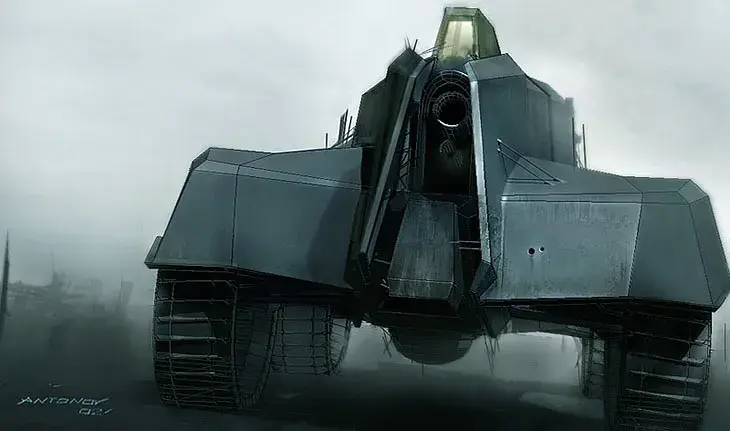
APC-14 | Light Armored Personnel Carrier
In the fragile early years of the occupation, the Combine identified a persistent weakness in its enforcement apparatus: resistance cells moved swiftly through contested terrain, and static patrols failed to close with them effectively. To address this, the Combine adapted terrestrial freight technology into a rolling bastion of firepower and troop mobility- what would come to be known among occupied populations as the Armored Personnel Carrier, or APC.
Heavily modified from captured industrial transport frames, the APC is more than conveyance. It is a mobile strongpoint, a fortress on wheels capable of penetrating hostile positions, delivering troops into contested zones, and providing suppressive fire sufficient to fracture coordinated resistance. Its presence reshapes battlefields and reshapes expectations of Combine reach.
Design and Capabilities
The APC’s chassis is an amalgam of thick composite plating, reinforced undercarriage armor, and adaptive suspension designed for rubble‑strewn streets and broken highways. Its wheels are broad and segmented, capable of traversing broken terrain that would stall less robust vehicles.
Mounted atop its reinforced flank is a pulse cannon, feared for its combination of sustained fire and explosive impact. This weapon cuts swaths through cover and obstacles, forcing entrenched insurgents into the open. Secondary turrets (smaller rapid‑fire pulse emitters) survey flanks and rear arcs, eliminating threats that would otherwise flank the carrier.
Inside, the cabin is cramped and fortified. Imported synthetic materials line the interior, shielding passengers from small arms fire and shrapnel. Civil Protection units, Overwatch Provisional Arm personnel, disembark only when the situation demands close‑quarters engagement.
Operational Role
APCs serve in multiple capacities:
- Rapid Response: When Overwatch detects insurgent activity outside the reach of standard patrols, APCs are deployed to intercept, contain, and compress resistance movement.
- Troop Transport: They deliver enforcement personnel quickly into contested corridors, abandoned districts, or high‑value infrastructure points.
- Fire Support: Their pulse weapon systems suppress enemy positions, break fortified lines, and dominate open engagement zones.
- Psychological Presence: The sound of an APC approaching carries weight; resistance forces often disband rather than face its advancing guns.
While not as numerous as Scanners or Sterilizers, the few deployed APCs ensure that no sector remains entirely beyond Combine control. Their mobility bridges the gap between static defense and active suppression.

ATC-C-155 | Advanced Transport Vehicle
With the world now secured by the Combine and APCs became the mainstay policing vehicles of the Civil Protection, the members of the Administration saw the need for a more off-road and robust version of the original APC-14. This is where a few cities dedicated some resources to, creating the first concept design of the ATC was released to the Protection Leadership in 2009.
With the design shown and some recommendations actioned, the first buildable design was made in 2011, the first production vehicle to hit the roads showing its versatility of various types of terrain using an AWD system and adjustable suspension, allowing it to easily climb steep hills, sandy, wet or even in some cases icy terrain. It was approved for full production in late 2011.
Design
The ATC-C-155 is a larger version of the Combine APC capable of carrying up to 10 to 15 Civil Protection Units. Mainly functioning as a transport vehicle similar to the original APC-14 but with a large variety of modifications and systems engineering, one such improvement is its armour plating as well as its newly improved MPPT-2 turret capable of firing 1600 bullets per minute. Another feature consists of its ability to carry far more units compared to its smaller brother as well as donning a frontal dark energy engine allowing it to travel at speeds of 75km/h on off-road terrain and providing a speed boost uphill or mountainous areas. Its suspension is superior to the APC-14 due to the larger wheel size and rainforest body frame.
There also exists the -1 and -2 variants of the ATC-C-155. The -1 variant of the ATC swaps out its transport system for a Command and Control center for on the move Outland Operations. The Command variant comes equipped with improved reactive armour plating, as well as a light-weight design, allowing the vehicle to transform into a FOB when not moving. Due to the weight increase from the Command and Utilities, it features a dual frontal dark-energy engine allowing it to travel at speeds of 105km/h on off-road terrain and providing a speed boost uphill or mountainous zones, this works in conjunction with its improved suspension, utilizing a reinforced frame and stronger hydraulics.
The -2 variant is the Utility version of the ATC, while not much different from its original counterpart, this vehicle is designed more for combat than transporting. Featuring a inbuilt weapon and ammo rack to supply local forces, as well as providing a new armament to the vehicle which is the DPC-4 (Direct-Fire Pulse Cannon). Similar to the -1, it also utilizes the same Dual-Engine setup.
General Characteristics:
Crew: 2 (Driver & Gunner)
Passengers: 10-15 (personnel transport configuration) 0 (all other configurations)
Length:
Height:
Empty weight (no modules):
Gross weight:
Powerplant:
Main Engine dimensions:
Performance
Maximum speed (Off-Road): 75 km/h (47 mph) - Other Variants: 105 km/h (65 mph)
Maximum speed (On-Road): 149 km/h (90 mph) - Other Variants: 193 km/h (120 mph)
Range: TBD
Armament: 1x Multi-Purpose Pulse Turret (MPPT-2)