
The Enforcers in the Streets
The Function of Urban Enforcement
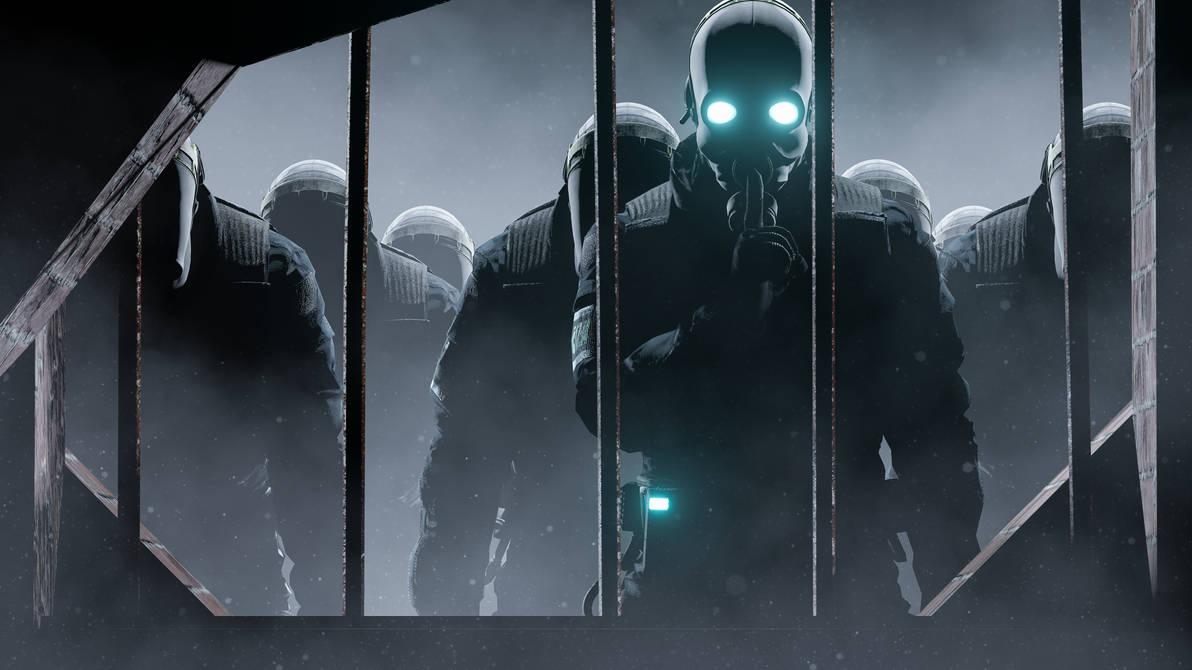
The Civil Protection arose in the early aftermath of the Seven Hour War, born from the necessity of turning the shattered human cities into manageable, compliant spaces. The Combine required an instrument capable of navigating the density and unpredictability of urban life, something- someone - that could recognise tension, sense unrest, and intervene before instability hardened into resistance. While synthetic forces are effective, they are also blunt; lacking the intuitive understanding required to mould a population rather than annihilate it which is where this human enforcement caste became essential.
Although not equipped for intensive combat, units are outfitted with a standard gear set designed for intimidation, control, and suppression. This typically includes:
- A reinforced urban Kevlar vest
- A full-body suit with biometric telemetry
- A respirator-mask system providing voice modulation and environmental filtration
- A
modified USP MatchP226 sidearm - A high-voltage stun baton, an post-war evolution of pre-war riot control tools.
Each unit is also connected via a neural interface to biosurveillance systems, allowing Dispatch to monitor health, location, and even emotional spikes in real time. In cases of an officer's death, this neural feedback typically triggers an automated broadcast—“Unit down, remaining stabilization team code: isolate” - followed by the deployment of reinforcements.
The true function of the Civil Protection was never protection, in reality they exist to make where they are stationed predictable. To protect the structure that controls them. They are the Combine’s most intimate extension into human space, walking the same streets while enforcing priorities wholly alien to those they govern.
Forging the Instruments of Compliance
This human enforcement did not begin as a refined institution, it emerged from the fragments of post-war desperation, built from volunteers seeking food and safety, opportunists hunting privilege, and loyalists who believed in survival through obedience. Recruitment is the first filter, separating those who could be shaped from those who would fracture under pressure. The training that follows is not merely an instruction but as an ideological induction where recruits learn that sociostability outweighs mercy, that hesitation endangers the city, and that compliance is both a duty and a currency.
The ranking structure within Civil Protection hardens this transformation. Advancement granted to those who proved consistent, disciplined, and aligned with the occupation’s logic. Threats ensured obedience and promises incentivised performance. Over time, a new archetype has emerged where units who did not simply follow orders but believed that the Combine’s rule brought clarity and purpose to a broken world, these visionaries becoming the backbone of the institution. They train others, uphold the doctrine and ensure that Civil Protection evolves beyond a stopgap measure into a permanent armature of enforcement and one day into a coherent mechanism engineered to maintain compliance across entire populations as the occupation develops into the future.
Ranking Structure | Description |
RcT 00 | Recruit is the first rank given to new units joining the Civil Protection. It is given for the duration of their induction and initial training on the basic operating procedures. Training generally consists of some initial classroom and practical lessons before the unit is sent out into the field. Field training happens under the close supervision of a senior unit. |
10-20 | As the first fully-fledged member rank of the Civil Protection, these units are considered to meet the quality requirements set out for units. The main goal of this rank is for the unit to gain experience and close any remaining knowledge gaps in day-to-day operating procedures. |
30-40 | After those with 10-20 RP gains enough experience, they will be promoted to this rank. At this rank, they are expected to be experienced in all day-to-day operations and have been through a couple of tough situations where they managed to hold their ground. These units should no longer be considered ‘green’ and should manage all code blue situations without requiring supervision. Given that achieving this rank is mostly a matter of experience, basically, all units that were good enough to reach 10-20 RPs can expect to reach this rank as well. |
50-70 | This rank contains a mix of veteran units and great performers being fast-tracked to higher ranks. Typically, intention three is the average stopping point of many careers within the Civil Protection should a unit not exceed expectations. |
80 | At 80 RPs, units start to hold some power towards the lower-ranked units, especially within the non-operational context. As veterans who know the operating procedures in and out, they are expected to be able to (and actively try to do so) train and supervise lower-ranked units. Operationally, they are good Protection Team leaders and can lead even under difficult circumstances. These units are distinguished by their blue armbands. |
90 | A unit’s first, total commitment to the powers that be. Being the official right-hand of the Rank Leaders, 90 RPs are expected to carry out the direct whims and wishes of their superiors, acting as de facto leaders whenever a Rank Leader may be offline. They are expected to have relatively clean records and exemplary performance throughout their career. These units are distinguished by their red armbands. |
Rank Leader 100 | The first formal leadership rank in the High Command system. Officers handle oversight of lower-ranked units, coordinate missions, and act as intermediaries between field units and upper command. |
Captain | The commanding officer(s) of the Civil Protection. They are tasked with overall leadership, coordination with Dispatch and City Administration, and implementation of Combine protocols at the city level. |
Upholding the Combine’s Mandate
Civil Protection operates under a mandate that descends from the highest levels of occupation authority. The average civil protection unit’s power on the street is broad but tightly contained within protocols designed to keep the force predictable and efficient. This authority permits detainment, interrogation, search, and correction, yet limitations ensure that such powers serve stability rather than indulgence. The Combine cannot afford an enforcement body that is cruel for its own sake or hesitant when firmness is required, both undermine stability and both will be corrected swiftly.
Nonetheless, the day to day operations of Civil Protection shifts from City to City but at its core purpose remains constant. Sociostability is maintained by patrolling residential and industrial sectors, questioning citizens, and updating profiles that track behaviour and risk. They man checkpoints that divide the city into controlled zones, conducting searches and seizing contraband for processing within the Nexus. When instability rises, they escalate to block inspections, curfews, and authorised raids, sealing districts, isolating unrest, and dismantling anti civil activity before it grows. Ration cycles tighten or loosen under their supervision, turning access to food into a measure of compliance.
However, the Combine recognises that the humans they relied upon also carry skills that cannot be replicated by synthetic precision alone. Many recruits arrived with backgrounds in medicine, engineering and more, the Combine saw little value in letting such expertise vanish into routine patrol work. The introduction of divisions allows the occupation to sort, refine, and weaponise those abilities. Each division turns human knowledge into a controlled asset, ensuring that every unit becomes more than a simple enforcer. They became a specialist working toward the same goal, a tool sharpened to sustain the architecture of order that held each city together.
Division | Description |
PATROL / UNION | Units without a division assignment. They handle standard enforcement duties such as patrols, citizen profiling, checkpoint work, searches, and curfew enforcement. They form the baseline manpower of Civil Protection. |
Revitalisation Division | Responsible for the upkeep and continuity of the occupation’s assets. These units provide emergency and long term medical care to officers, maintain and repair Combine infrastructure, and ensure that critical equipment, scanners, barricades, and mechanical systems remain operational. |
Stabilisation Division | The tactical arm of Civil Protection. These units are responsible for planning and coordinating enforcement strategy. They train other officers in positioning and discipline, guide response teams during instability, and ensure that force is applied efficiently and in service of sociostability. |
Investigation Division | Focused on identifying, tracking, and dismantling threats to sociostability. These units gather intelligence, conduct surveillance, interrogate suspects, and map anti civil networks. They coordinate closely with command to preempt unrest before it manifests. |
Internal Affairs | A subdivision within Investigations dedicated to maintaining procedural integrity and discipline. Internal Affairs investigates misconduct, corruption, negligence, and behavioural risks among officers. Its purpose is to preserve internal stability and ensure that enforcement remains predictable and compliant with Combine doctrine. |